
To be frank, it did not all start last year.
There are a lot of underlying stories behind how Acadeva has become what it is today. Stories that cut across our different backgrounds as co-founders, the core problem we chose to tackle, how we came to understand it better, and most importantly, how we evolved our solution over time to match the reality of that problem.
When we started Acadeva, we set out to solve everything a university student was experiencing. There were so many problems we knew about, including payments of dues, access to study materials, scheduling, and student communication. Not like we knew how to solve these problems or had any significant prior experience. For me, a lot of the motivation came from Google DevFest 2024. One of the speakers, David Inyang-Etoh, spoke about leveraging AI capabilities for everyday solutions. The entire event gave me the drive to go out there and build. I started reading more, learning more, and experimenting more. Looking back, 2024 was a year of learning for most of the founding team.
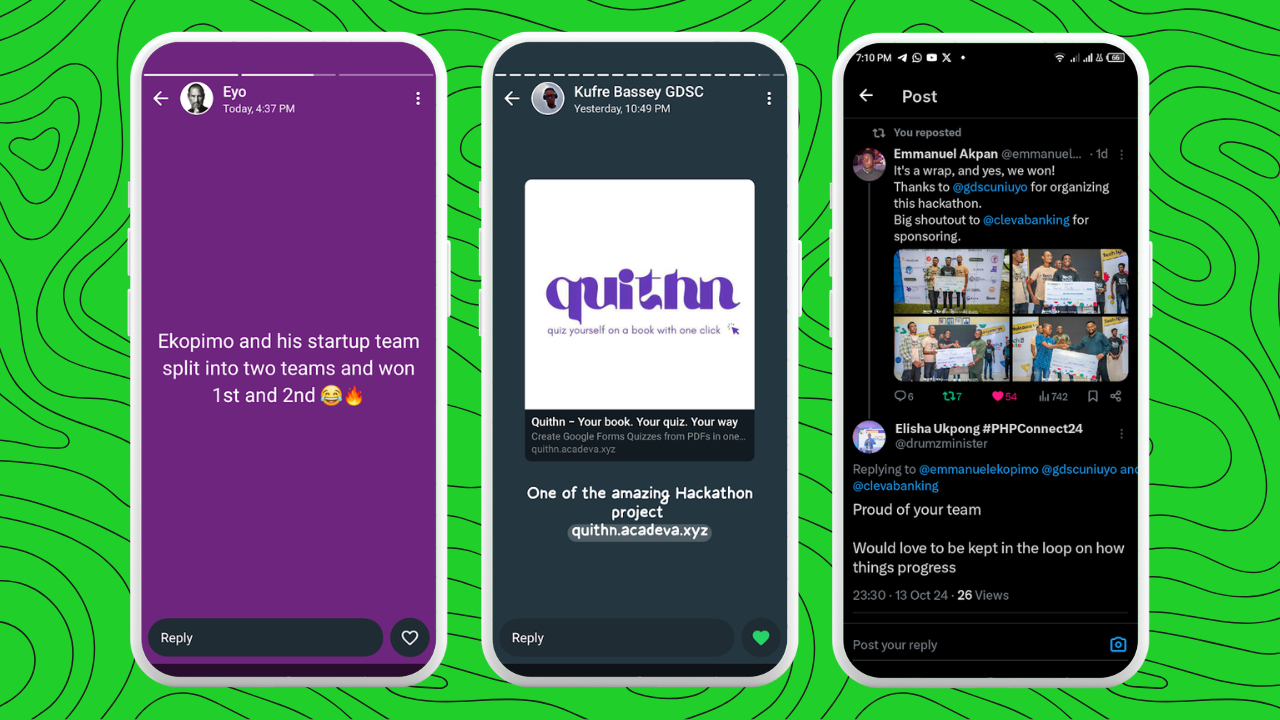
Later in 2024, we applied for a hackathon. Interestingly, it started as a joke because I genuinely did not think we stood a chance. Surprisingly, we won. What happened next caught us off guard. People wanted us to continue. They wanted us to build a full-fledged quiz generator from textbooks. We had traction that I never expected. By this time, the foundations of Acadeva were beginning to form.
The funny thing is that I already had a prototype of Acadeva. It was faulty, incomplete, and honestly did not solve any meaningful problem. Looking back, the reason was obvious. We were trying to build an "everything app." The original plan was ambitious: news, books, scheduling, and a social platform where students could find everything they needed in one place. It turns out that you cannot run around trying to fix every problem at once. Still, I pushed for a launch. The product was incomplete, buggy, and unstable. It did not even have the basic functionality required to upload books properly. Downloading books was unreliable and often failed completely. Yet we kept going.
The launch date itself carried personal meaning. June 16 is the day my grandmother, Edima, passed away, and June 23 is my dad's birthday. I averaged both dates, got 19.5, rounded it up, and landed on June 20. So on June 20, 2025, Acadeva was launched publicly on the Google Play Store and on the web for mobile users. Before then, we had already distributed beta versions to internal testers and carried out several rounds of testing.
Many people think launch day is where the work ends. We quickly discovered that launch day is where the real work begins. Feedback started pouring in immediately. We had built so much anticipation around the launch that the pressure became intense. Features broke, systems failed, and things fell apart far more often than we wanted. We continued fixing and improving the platform, but there was a deeper problem. We were trying to solve too many things at once. Because we were spread across so many problems, we could not solve any one problem exceptionally well.
One example was our scheduling system. Wiseman and I spent more than three months in 2025 building a synchronization system that could work reliably under intermittent network conditions. Technically, it was a challenge we were proud of. Students barely used it because it was too complex and required too much explanation. That realization changed how we thought about product design. We spent the next six months simplifying the experience because we strongly believe that if a basic feature requires a YouTube tutorial before users can understand it, then we have failed. Good products should explain themselves.
November 2025 became another defining moment. We attended a pitch event where one lesson stood out above everything else: focus. At the time, we did not have it. When the judges asked what Acadeva was, we struggled to answer clearly. We could explain many features, but we could not explain the product. We did not make it to the finals. That evening, Joseph and I went home disappointed because deep down we knew the judges were right. That same night, we started removing features. We cancelled ideas we had spent months building. Over the coming weeks, we cleaned up screens, removed buttons, simplified workflows, and narrowed our focus to two things: Study Resources and Schedule. That decision changed everything. We ended 2025 focused on making those core experiences work exceptionally well.
Another consequence of our lack of focus was how we viewed competition. During that period, we spent a lot of energy worrying about products that were never really our competitors. Because Acadeva was trying to do so many things at once, every student-focused app looked like a threat to us. We looked at platforms such as Scholarly, Sizzle, School Hack, and many others and convinced ourselves we were competing directly with them. In reality, we had so many competitors in our heads because we had not yet clearly defined what Acadeva was.
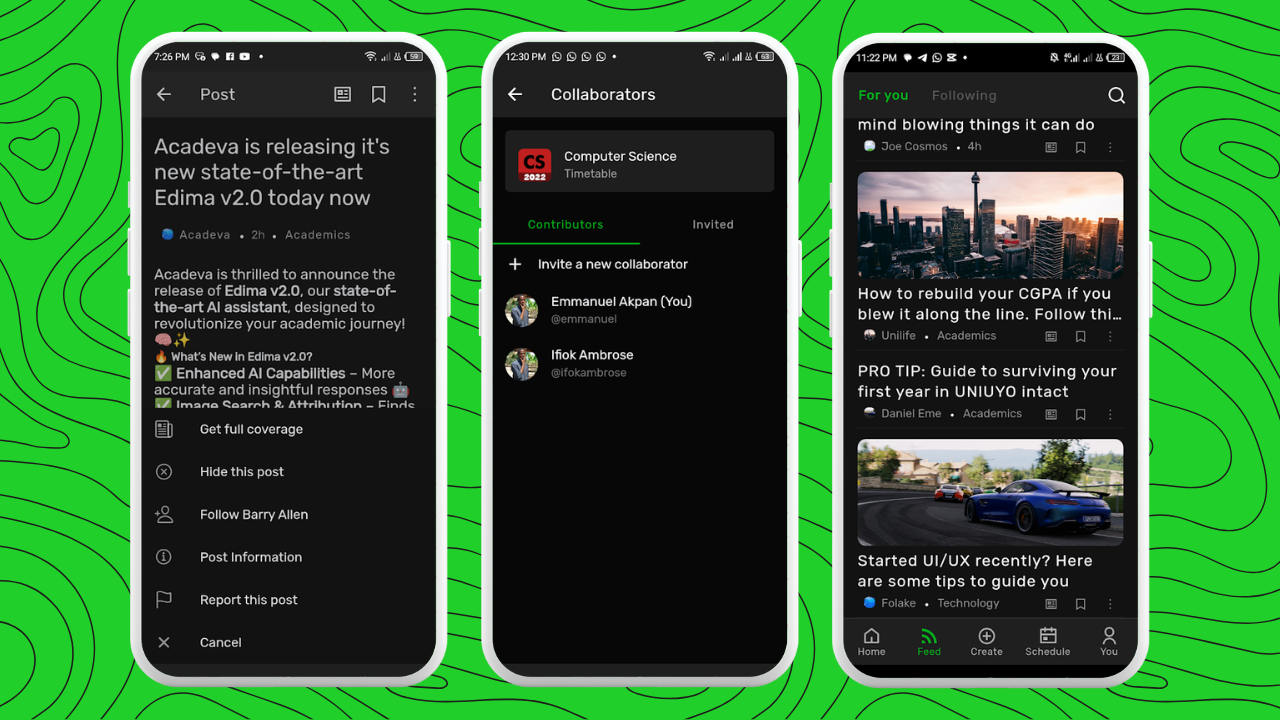
Acadeva trying to be an everything app
As we became more focused, our understanding of the market improved. By 2026, after narrowing our efforts around study resources and student learning, we were finally able to identify who our actual competitors were and, more importantly, why students would choose one platform over another. What we discovered was interesting. Many platforms had impressive features on paper, but struggled with one fundamental challenge: getting quality study materials into the hands of students in a structured and scalable way. Without a strong system for uploading, organizing, processing, and sharing academic materials, content libraries often remained sparse, making it difficult for students to consistently find what they needed.
This realization gave us confidence. We had spent months building the infrastructure behind study resources, sometimes without fully appreciating its importance. The systems for uploading books, processing them, organizing them, and making them discoverable were not just supporting features. They were becoming one of Acadeva's core strengths. For the first time, we stopped looking sideways at every student app and started focusing on the problem we understood best. That shift in mindset allowed us to spend less time reacting to others and more time building what students actually needed.
Then came 2026. February brought a new challenge. Our department wanted us to put their books on Acadeva. Ironically, this happened because we had offered to. Looking back, we are incredibly grateful for that opportunity. What would normally have taken us months to build was compressed into a few intense weeks. We built systems for uploading, processing, indexing, and organizing books. We also worked closely with Confidence Banny, Director of Academics at the Faculty of Computing, University of Uyo, testing different ways of organizing study resources inside Acadeva.
March became another redefining moment. We began researching what the perfect study-resource organization system should look like. We analyzed data from our previous iterations, studied student behavior, and reviewed every assumption we had made. Eventually, we landed on something simple: Course-Based Study. Students already study by course. Instead of forcing new behavior, we decided to build around existing behavior. That insight led to months of implementation work throughout March and April. For the first time, it felt like we had discovered the foundation we wanted to build upon for years to come.
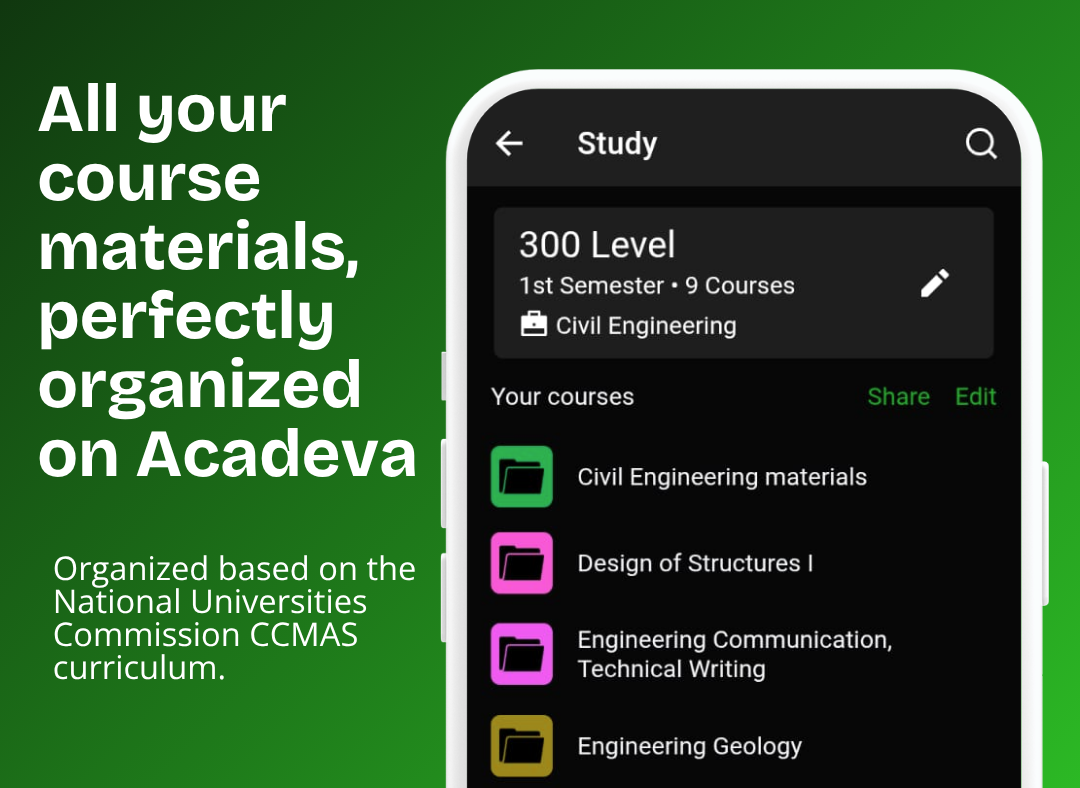
Course based study on Acadeva
During this same period, we achieved something that had sounded almost impossible in 2025. Acadeva launched on the App Store. What once felt like a distant dream became reality, opening the platform to iOS users. Then came May 11, 2026. We released Acadeva 2.0. Course-Based Study was finally live. It was a breakthrough moment. Adoption began growing steadily. Students found it easier to discover materials, navigation became clearer, and the platform finally started feeling aligned with the way students naturally learn. The weeks that followed were filled with bug fixes, refinements, and continuous improvements.
One thing we have become increasingly intentional about throughout 2026 is reducing complexity. Earlier versions of Acadeva suffered from a problem that many builders did not notice until much later: we understood the product better than our users did.
Over time, we realized that making powerful tools is only half the job. The other half is making sure people immediately understand how to use them. We began questioning everything, from feature workflows to naming conventions. We discovered that many of the names we had created internally felt clever to us but created unnecessary friction for students. Features with names like Quithn, Calzygen, and others required explanation before their value became obvious. Students had to stop and think about what a feature did before they could use it.
That may seem like a small problem, but small moments of confusion compound quickly. Every extra second spent trying to understand an interface is time not spent studying.
As a result, much of our work in 2026 has gone beyond building new features. We have spent considerable effort simplifying existing ones. We have renamed tools, refreshed icons, rewritten descriptions, reorganized interfaces, and continuously removed complexity wherever we find it. The goal has never been to make Acadeva look different. The goal has been to make Acadeva easier to understand.
This philosophy now influences nearly every decision we make. We are choosing clarity over cleverness, understanding over uniqueness, and simplicity over unnecessary complexity. The best feature is not the one with the most impressive technology behind it. It is the one students can immediately understand and confidently use. While many of our recent improvements may appear small on the surface, together they represent one of the most important shifts in how we build products. Here is the full story: We are done confusing everyone
Today, we measure progress differently. There was a time when we counted accounts. Now we count value. How long do students stay? Do they return? Do they find what they need? Do they voluntarily tell their friends about it? Those are the metrics that matter, and thankfully, we have seen steady improvements across them. We now operate with a solid roadmap that guides our decisions. While we continue shipping fixes and small improvements daily, our direction is much clearer than it has ever been.
The founding team has evolved too. The team you see today is a hard-headed team working on difficult problems. When we started, we thought this journey would be hard. It turns out it is far crazier than we imagined, and yet we would not trade it for anything.
As we mark one year of Acadeva, our greatest gratitude goes to the students who believed in us before we had anything substantial to show. The students who tested broken features, reported bugs instead of uninstalling the app, shared feedback when things did not work, and kept opening Acadeva even when we were still figuring things out. Many of you have watched Acadeva transform from an ambitious idea into something increasingly useful. You witnessed the mistakes, redesigns, failures, pivots, and breakthroughs. You gave us the opportunity to learn in public.
We are equally grateful to every lecturer, department, faculty representative, collaborator, friend, supporter, and member of the Acadeva community who has contributed in one way or another. Every conversation, suggestion, book uploaded, bug report, referral, and word of encouragement helped move Acadeva forward. Building a product is often portrayed as the work of founders, but Acadeva has been shaped by an entire community of people who cared enough to help us improve.
The story of Acadeva is still being written. One year later, we are more focused than ever, more convinced than ever, and more excited than ever. What we have built over the last year is important, but what lies ahead is even more exciting.
A year of Acadeva. A future of possibilities.